
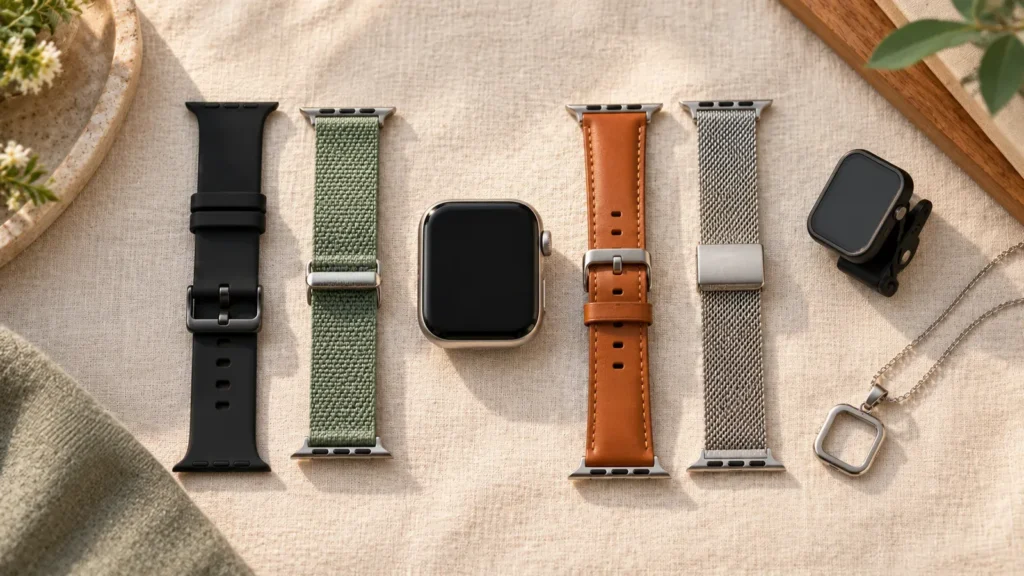
The Apple Watch was designed for the wrist, but that is not the only place it works. Nurses clip it to a scrub top, cyclists mount it on handlebars, and some people simply prefer not to wear anything on their wrist all day. This guide covers 10 alternative ways to wear an Apple Watch and the band or accessory each one needs.
Before you move it, though, it helps to know what changes once the watch leaves your wrist. That part is covered first, followed by 10 practical alternatives and the type of band each one needs.
What changes when your Apple Watch isn’t on your wrist
Several Apple Watch features depend on Wrist Detection, which uses the sensors on the back of the case to confirm the watch is touching your skin (Apple explains how this works in its guide on why an Apple Watch locks unexpectedly). When the watch is worn somewhere else, expect a few trade-offs:
- The watch locks itself. When it no longer detects your wrist, it locks and asks for your passcode. You can turn Wrist Detection off in the Watch app on your iPhone (My Watch > Passcode), but doing so also turns off some health and safety features.
- Apple Pay asks for your passcode more often. Payments are tied to the watch staying unlocked on your wrist.
- Heart rate, blood oxygen and ECG readings need skin contact. In a pocket, on a bag or on a handlebar, these readings won’t be available.
- Step and activity tracking can be less accurate. The watch estimates movement from arm motion, so a different position changes what it measures.
- Fall Detection is designed for wrist wear. If you rely on it, keep the watch on your wrist when that matters most.
Notifications, the time, timers, the flashlight, Find My and most apps keep working wherever the watch is, so most alternative ways to wear an Apple Watch still give you the features you use every day.
10 alternative ways to wear an Apple Watch
1. On the inside of your wrist
This is the smallest change and keeps every feature working. Flipping the case to the inside of your wrist protects the screen from bumps on desks and doorframes, and many people find it easier to glance at while typing or carrying bags. Any standard band works; a soft sport loop or silicone band is the most comfortable in this position.
2. On the other wrist
If you’ve always worn it on your left wrist, try the right. Go to Settings > General > Orientation on the watch and choose the wrist and Digital Crown side. Left-handed people and anyone whose dominant hand keeps hitting the crown often prefer this.
3. On your ankle
Some people wear an Apple Watch on the ankle while cycling, spinning or doing work that keeps their hands busy. You need a longer band, usually an extra-large sport loop or an extender, and it should sit snugly above the ankle bone. Readings in this position are not what the watch was calibrated for, so treat the numbers as rough.
4. On your upper arm
An upper-arm or bicep band keeps the watch out of the way during weightlifting, boxing and climbing, where a watch on the wrist gets in the way of grips and gloves. Look for a wide elastic band with a cradle for the case.
5. As a nurse’s fob or clip-on watch
Many healthcare workers can’t wear anything on their wrists because of hand-hygiene rules. A clip holder that attaches to a pocket or scrub top turns the watch into a fob watch. You can still read the time, use timers and get notifications without touching patients with your wrist.
6. As a pendant on a necklace
A pendant adapter connects to the band slots and hangs from a chain or cord. It’s a popular option at formal events when you want to stay reachable without a smartwatch on your wrist, and for people who find wrist wear uncomfortable.
7. As a pocket watch
Attach a short chain or a leather fob to the band slots and keep the watch in a waistcoat or jeans pocket. It’s mostly a style choice, but it also keeps the screen protected when you work with your hands.
8. On a bike handlebar or stroller
A handlebar mount holds the watch in view while you ride, like a small bike computer. Parents use the same type of mount on stroller handles. The watch can’t measure heart rate here, so it works best for time, navigation and workout timers.
9. On a backpack strap or belt loop
A short strap or carabiner holder lets you hang the watch from a bag strap or belt loop. Hikers sometimes use this to keep the screen visible when wearing thick gloves or long sleeves.
10. As a bedside clock
Put the watch on its charger on its side and it switches to Nightstand mode, showing the time and any alarms you’ve set. A charging stand keeps it upright and turns it into a compact alarm clock, which is useful if you don’t sleep with it on.
Which band you need for each way to wear an Apple Watch
| Way to wear it | What to use |
|---|---|
| Inside of the wrist, other wrist | Any standard band; sport loops and silicone bands are the most comfortable |
| Ankle | Extra-long sport loop or a band extender |
| Upper arm | Wide elastic arm band with a case cradle |
| Nurse fob, pocket, backpack | Clip-on holder or short strap that fits the band slots |
| Necklace | Pendant adapter with a chain or cord |
| Handlebar or stroller | Bike or handlebar mount |
| Bedside | Charging stand |
Check the size before you buy
Every accessory that clips into the band slots needs to match your case size, whichever alternative way to wear your Apple Watch you choose. Apple Watch bands fall into two groups:
- Smaller cases: 38mm, 40mm, 41mm and 42mm (Series 10 and later)
- Larger cases: 42mm (Series 1–3), 44mm, 45mm, 46mm and 49mm (Ultra)
Bands within the same group are interchangeable, so a 44mm band also fits a 45mm watch. If you’re not sure of your case size, it’s engraved on the back of the case.
FAQ
Can I wear my Apple Watch on my ankle?
Yes, with a longer band. The watch will still show the time and notifications, but heart rate and activity data will be less reliable because the sensors are designed for the wrist.
Does the Apple Watch work if it’s not touching skin?
Yes. It will lock and ask for your passcode, and it can’t take heart rate or ECG readings, but notifications, timers and apps still work.
Can nurses wear an Apple Watch at work?
Many hospitals don’t allow anything on the wrists during patient care. A clip-on fob holder is a common way to keep the watch visible on a scrub top instead.
Find a band for your alternative way to wear an Apple Watch
Whether you’re flipping it to the inside of your wrist or moving it to your ankle, the band makes the difference. Browse our Apple Watch bands, available in sizes for every case and shipped to the US, UK, Canada, Australia and New Zealand.

Comments