
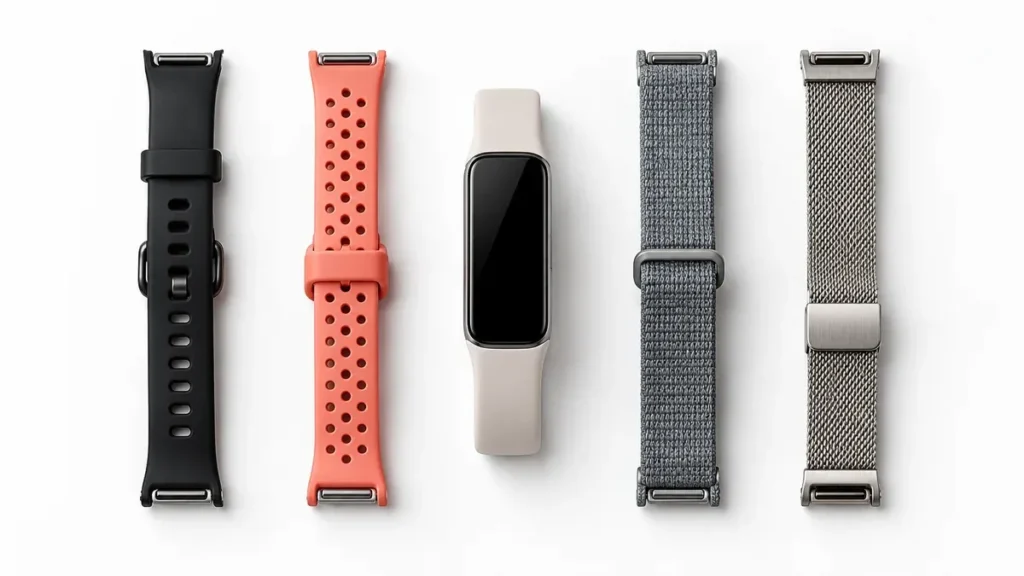
The best Fitbit band is one made for your exact model. Fitbit bands aren’t interchangeable across families, so a Charge 6 band won’t fit a Versa 4. Once the fit is right, pick silicone for workouts and swimming, a woven nylon loop for all-day and sleep comfort, and metal or leather for the office.
Disclosure: SmartwatchAdviser sells some of the bands recommended in this guide. We only feature bands we would suggest regardless.
A new band is the cheapest, fastest way to make a Fitbit feel new again — more comfortable on a run, dressier for work, or just a color you actually like. But there’s one thing almost every shopper gets wrong: Fitbit bands are not universal. A band made for one Fitbit usually won’t fit another, and buying the wrong one is the most common reason a “replacement band” ends up back in the box. This guide walks you through exactly how to pick a band that fits your Fitbit, feels good all day, and lasts.
Fitbit bands aren’t one-size-fits-all — know your model first
Every modern Fitbit uses a quick-release band system, but the connector shape and size differ from model to model. That means a band is tied to a specific family of devices, not to “Fitbit” in general. Before you buy anything, confirm your exact model and look for a band that lists it by name. Here’s the short version of what shares with what:
Charge series: The Charge 5 and Charge 6 use the same bands. The older Charge 3 and Charge 4 share a different band with each other, and neither fits the Charge 5/6.
Versa & Sense series: The original Versa, Versa 2, and Versa Lite use one band style, while the Versa 3, Versa 4, Sense, and Sense 2 use a different one. The Luxe uses its own slim, proprietary band that does not fit any Versa or Sense. Don’t assume a Versa 2 band will fit a Versa 4 — it won’t.
Inspire series: The Inspire and Inspire HR share bands, but the Inspire 2 and Inspire 3 each use their own band and are not interchangeable with each other.
Fitbit Air: The newer Fitbit Air has its own dedicated band system, so you need bands made specifically for it.
Ace (kids’ trackers): These don’t use the standard quick-release design — the tracker pops into a holder in the middle of the band — so they aren’t interchangeable with the adult models.
The takeaway: a listing that just says “fits Fitbit” isn’t enough. Match the band to your specific model, every time.
Which Fitbit band do I need?
If you’re not sure which Fitbit you have, check the back of the tracker (the model is often printed there) or open the Fitbit app — your device name is listed under your account. Once you know the model, you’ll also usually choose a size: most Fitbit bands come in Small and Large. Measure your wrist with a flexible tape or a strip of paper just above the wrist bone; if you’re between sizes or your wrist swells during exercise, size up or pick an adjustable style.
Fitbit band compatibility at a glance
| Fitbit model | Shares bands with | Band type |
|---|---|---|
| Charge 5, Charge 6 | Each other | Charge 5/6 quick-release |
| Charge 3, Charge 4 | Each other | Charge 3/4 quick-release |
| Versa, Versa 2, Versa Lite | Each other | Original Versa clasp |
| Versa 3, Versa 4, Sense, Sense 2 | Each other | Infinity-style band |
| Luxe | None (proprietary) | Slim Luxe band |
| Inspire, Inspire HR | Each other | Inspire band |
| Inspire 2 | None (model-specific) | Inspire 2 band |
| Inspire 3 | None (model-specific) | Inspire 3 band |
| Fitbit Air | None | Fitbit Air connector |
When a listing does not name your exact model, check it against Fitbit’s official Fitbit help pages before buying.
Our top band picks by Fitbit model
These are the styles we would choose for each Fitbit family, based on comfort, durability and value. We stock bands for the Fitbit Air; for other models we point you to the style that tends to work best.
- Fitbit Air: for everyday and sleep, the breathable nylon braided performance loop; for workouts and easy cleaning, the magnetic silicone sport strap. More in our best Fitbit Air bands guide.
- Charge 5 / Charge 6: Fitbit’s own fluoroelastomer Sport Band is a safe, well-fitting default; for daily wear, a perforated third-party silicone band, or a woven nylon band if silicone irritates your skin.
- Versa 3 / Versa 4 / Sense / Sense 2: Fitbit’s official Infinity Band gives a seamless, clasp-free look; otherwise a soft silicone band for everyday, or a breathable nylon band for the gym.
- Versa / Versa 2 / Versa Lite: a classic buckle silicone band with ventilation holes.
- Luxe: a slim band made specifically for the Luxe — its proprietary fitting will not take Versa or Sense bands.
- Inspire family: a lightweight sport band keeps these slim trackers comfortable for all-day and sleep wear.
In our own testing, a braided nylon loop held up best after a month of daily workouts, while the cheapest silicone bands started to crack at the lugs — one reason we favour a quality weave and fluoroelastomer over bargain multipacks.
How to remove and attach a Fitbit band
Swapping a band takes about ten seconds once you’ve done it:
To remove: Turn the tracker over. Find the small quick-release latch where the band meets the device, press it in with a fingernail, and gently pull the band away at a slight angle. Repeat on the other side.
To attach: Hold one end of the new band at about a 45-degree angle, slot its pin into the groove on the tracker, and push until you hear a light click. Do the same on the other side, then tug gently to make sure both ends are locked before wearing it.
New to swapping bands? Our step-by-step guide on how to change a watch band covers the quick-release method in detail.
(A few models use a pin-and-peg design instead — insert the bottom half first, then slide the top until it clicks.)
Best band styles, by how you’ll use it
Once you’ve sorted compatibility, picking a style is the fun part. Here’s what each material does best.
Silicone / sport bands
The everyday default. Soft silicone handles sweat, showers, and swimming, wipes clean in seconds, and is usually the cheapest option. It’s the right pick if you work out or wear your Fitbit all day without thinking about it.
Woven nylon & sport loops
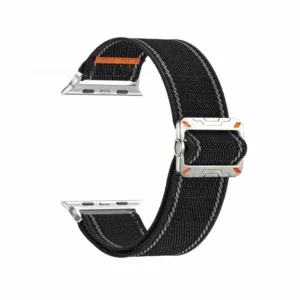
The comfort choice. A woven nylon loop is light, breathable, and adjusts to any wrist with a hook-and-loop closure, so there’s no fixed hole to land between — ideal for all-day wear and sleeping with your tracker on. The trade-off is that fabric holds sweat and odor, so it needs an occasional wash.
Breathable perforated bands
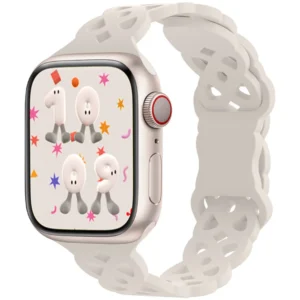
Perforated silicone gives you the easy-clean benefits of rubber with extra airflow, which helps in hot weather and during hard workouts where a solid band can trap sweat against the skin.
Metal mesh & link bands
For a dressier look, a mesh or link bracelet turns a fitness tracker into something that works with office wear. Metal is durable but heavier, and link bands usually need sizing to fit. Not the best choice for heavy exercise.
Leather bands
Leather looks sharp for the office or an evening out, but it doesn’t like sweat or water — keep it for lighter-wear days and swap to silicone for workouts.
What size Fitbit band should I get?
Comfort starts with fit. A band should sit snugly enough that the sensor stays in contact with your skin, but loose enough to slide slightly — roughly a finger’s width of room. Too tight traps sweat and irritates the skin; too loose and your heart-rate and sleep data suffer. If you’re on the edge between Small and Large, an adjustable nylon loop or buckle strap is the safest bet because it fine-tunes to your wrist instead of jumping between fixed holes.
Comfort and avoiding skin irritation
Wrist irritation is one of the most common Fitbit complaints, and it’s usually about care and fit rather than the band itself. A few habits prevent most of it:
Keep the band and your wrist clean and dry — trapped sweat, soap residue, and moisture under a tight band are the usual culprits behind redness. Don’t wear it so tight that it leaves a mark, give your skin a break by taking the tracker off for a while each day, and let the band dry fully after workouts or showers. If your skin is sensitive, lean toward breathable woven nylon or soft, high-quality silicone, and consider rotating between two bands so each has time to dry out. If irritation persists, loosen the fit and switch materials before anything else.
Keeping your band clean
Silicone: Rinse under warm water, use a little mild soap for stubborn grime, and dry it fully before putting it back on.
Nylon/woven: Hand-wash in lukewarm soapy water, rinse well, and air-dry completely — never put it back damp.
Metal: Wipe with a soft, slightly damp cloth and dry it; a soft brush clears dust from between the links.
Leather: Wipe clean with a dry or barely damp cloth and keep it away from water.
Avoiding cheap, low-quality bands
Search any Fitbit model and you’ll find hundreds of near-identical no-name bands, and the quality varies enormously. A bad one can arrive with a loose connector that pops off and loses your tracker, stiff silicone that smells of chemicals, or coating that flakes within weeks. Protect yourself by choosing a band that clearly lists your exact Fitbit model, states a real size range, and is sold honestly as compatible (not a fake “official” Fitbit product) by a seller who stands behind it. A slightly higher price from a reputable source beats replacing a cheap band — or a lost tracker — a month later.
Shop bands for your Fitbit
We specialize in bands for the Fitbit Air, with styles for every use case: a breathable nylon braided performance loop for all-day and sleep comfort, an easy-clean magnetic silicone sport strap for workouts, and more — all compatible with the Fitbit Air (not official Fitbit products). Browse the full range in our Fitbit bands collection, and for a closer look at the best options, see our guide to the best Fitbit Air replacement bands.
Frequently asked questions
Are Fitbit bands interchangeable between models?
Generally no. Bands are specific to a model family — for example, Charge 5 and Charge 6 share bands, but a Versa band won’t fit a Charge, and a Fitbit Air needs its own bands. Always match the band to your exact model.
How do I know what size band to get?
Most Fitbit bands come in Small and Large. Measure your wrist just above the wrist bone and check the band’s listed size range. If you’re between sizes, choose an adjustable loop or size up.
Why does my wrist itch under my Fitbit?
Usually trapped moisture, a too-tight fit, or soap residue — not the band material. Keep the band clean and dry, loosen it slightly, give your skin regular breaks, and try breathable nylon if your skin is sensitive.
Do third-party Fitbit bands fit as well as official ones?
Many are excellent and far cheaper. The key is buying one that lists your exact model, fits the quick-release connector properly, and is sold as compatible rather than as a counterfeit “official” band.
How do I change a Fitbit band?
Press the quick-release latch on the underside, pull the old band away at an angle, then slot the new band in until it clicks on both sides. No tools needed.

Comments