
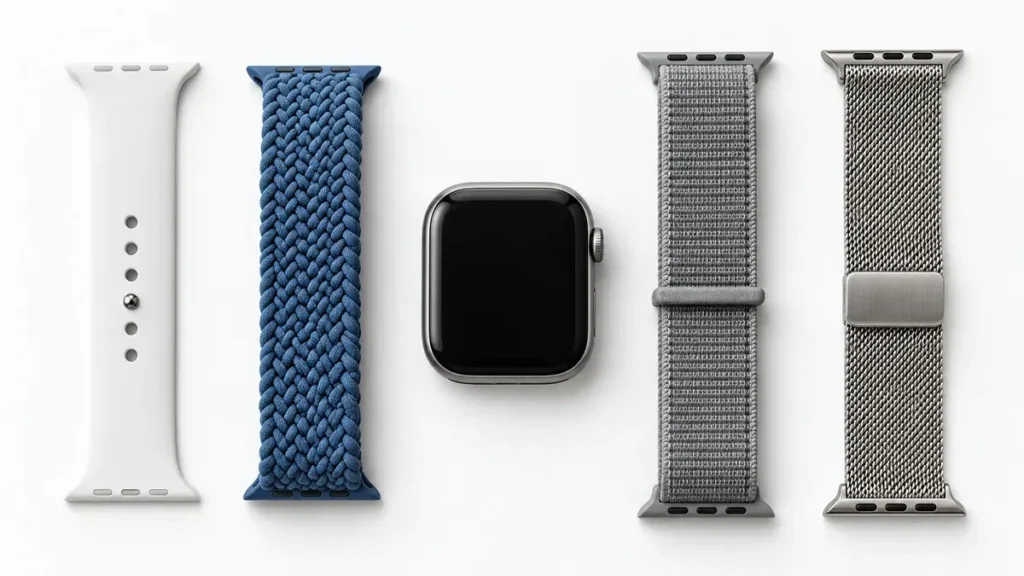
Few upgrades change your Apple Watch as cheaply as a new band — and few choices come with as many options. The good news: swapping bands takes seconds and your old bands keep working on new watches. The two things that actually trip people up are picking the right size and deciding whether Apple’s pricey official bands are worth it over a good third-party one. This guide settles both, then helps you find the most comfortable band for how you actually wear your watch.
Which bands fit your Apple Watch?
Apple Watch bands aren’t sized per model — they’re grouped by case width, and every band within a group is interchangeable:
Small group (38mm / 40mm / 41mm): Series 1–3 were 38mm, Series 4–6 and SE are 40mm, Series 7–9 are 41mm. Any band for one fits them all. The Series 10’s 42mm case also takes these smaller bands.
Large group (42mm / 44mm / 45mm / 49mm): Older 42mm, then 44mm (Series 4–6/SE) and 45mm (Series 7–9) all share bands. The Series 10’s 46mm case and the Apple Watch Ultra (49mm) take these larger bands too, though some Ultra styles like the Trail and Alpine Loop are built for its rugged case.
The best part: because Apple has used the same slide-in lug system since Series 1, a band you bought years ago still fits the newest watch in its size group — no need to re-buy your collection when you upgrade.
Not sure which size you have? It’s engraved on the back of the watch, or listed under General > About in the Watch app. Buy a band labeled for your group and you’re set.
Are Apple’s official bands worth it, or is third-party just as good?
This is the question Apple Watch owners ask most, and the honest answer is: it depends on the band. Apple’s own bands are genuinely well-made and come in premium finishes, but you pay a steep premium for the name — often $49 to $99 for a strap that costs a few dollars to produce.
A good third-party band matches the official ones closely on material, comfort, and the all-important connector fit, for a fraction of the price — which is why many people own one or two Apple bands and a drawer of affordable alternatives for everything else. The catch is quality varies, so buy from a seller who lists your exact size group, describes the real material, and sells the band honestly as compatible with the Apple Watch (not a counterfeit “official” product). Done right, you get 90% of the experience for a tenth of the cost.
The most comfortable bands for all-day and sleep wear
If you wear your watch around the clock — including to bed for sleep tracking — comfort beats looks. The most comfortable styles share one trait: no bulky clasp digging into your wrist.
Braided Solo Loop is the standout for all-day and overnight wear. It’s a single stretchy woven loop with no buckle at all, so it’s soft, light, and has nothing to press into your skin while you sleep. A braided solo loop band slips on like a bracelet and disappears on the wrist.
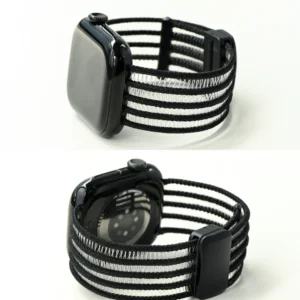
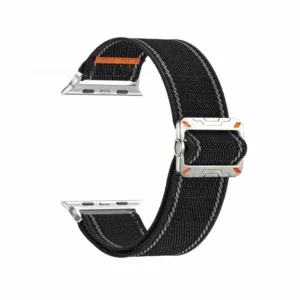
Sport Loop is woven nylon with a hook-and-loop closure — breathable, endlessly adjustable, and great for sensitive skin. An elastic nylon band with a low-profile magnetic clasp gives you the same soft comfort with easy on-and-off; our elastic nylon band with a magnetic clasp is a comfortable everyday pick.
Best bands by how you’ll use it
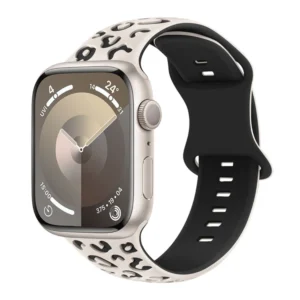
Workouts & water: Soft silicone is the go-to — it shrugs off sweat, rinses clean, and won’t slip when you’re moving. A semi-transparent ocean-style silicone band handles gym sessions and swims without fuss. Breathable sport loops also work well for high-sweat activity.
Everyday: A braided solo loop or a classic silicone sport band covers most days comfortably.
Dressy: A Milanese or link bracelet dresses the watch up for the office or an evening out — durable, but heavier and usually in need of sizing.
Rugged & outdoor: For hiking or the Apple Watch Ultra, a tough nylon loop with a secure pull-through closure stays put on the trail. Our Trail and Alpine Loop nylon bands for the Apple Watch Ultra are built for exactly that.
The Solo Loop sizing trap — measure before you buy
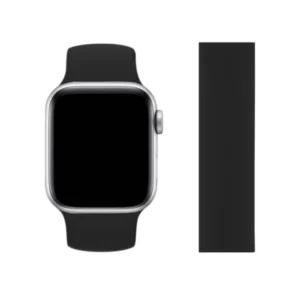
Here’s the mistake that sends more Apple Watch bands back than any other: the Solo Loop and Braided Solo Loop have no clasp or adjustment, so they only fit if you order the exact right length. Too big and it slides around; too small and you can’t get it on.
Before buying either style, measure your wrist: wrap a strip of paper or a tape measure snugly around your wrist just below the wrist bone, mark where it overlaps, and check that measurement against the band’s size chart (Apple also offers a printable sizing guide you can wrap around your wrist). This one step saves a return. Adjustable styles — sport loops, buckles, and magnetic clasps — don’t need this, which is another reason they’re the safer first buy.
Material safety and avoiding skin irritation
Wrist irritation under a smartwatch is common, and it’s usually about fit and hygiene rather than the band itself. Keep the band and your wrist clean and dry, don’t cinch it so tight that it leaves a mark, and give your skin a break by taking the watch off for a while each day. If your skin reacts easily, choose a breathable woven nylon or soft, skin-safe silicone and avoid trapping sweat underneath. Rotating between two bands so each dries out fully helps too. Buy from sellers who describe the material honestly — quality silicone and nylon are far less likely to irritate than cheap, strong-smelling alternatives.
Which bands last longest
Durability tracks with material and construction. Silicone and woven nylon hold up well to daily wear, sweat, and water. Where cheap bands fail is at the clasp and the connector — flimsy magnets, thin pins, or flaking metal coatings — so a band that feels solid where it attaches will usually outlast one that just looks good in photos. Textile bands with glued or coated finishes tend to wear fastest.
How to change an Apple Watch band
Swapping takes seconds and needs no tools. Hold the watch face-down, press and hold the small band-release button on the back, and slide the band sideways out of its channel. To attach, slide the new band into the channel until it clicks. Make sure each half goes in the right way up, and give it a gentle tug to confirm it’s locked.
Keeping your band clean
Silicone: Rinse under warm water, use a little mild soap for grime, and dry fully before wearing.
Nylon/woven: Hand-wash in lukewarm soapy water, rinse well, and air-dry completely — never put it back damp.
Metal: Wipe with a soft, slightly damp cloth and dry it; a soft brush clears dust from the links.
Shop bands for your Apple Watch
We carry comfortable, well-made Apple Watch bands at a fraction of Apple’s prices — all compatible with the Apple Watch (not official Apple products). For all-day comfort try the braided solo loop or the elastic nylon band with magnetic clasp; for workouts and water the ocean-style silicone band; and for the Ultra or the outdoors the Trail and Alpine Loop. Browse everything in our Apple Watch bands collection.
Frequently asked questions
Do all Apple Watch bands fit all models? Within a size group, yes. Bands for 38/40/41mm are interchangeable, and bands for 42/44/45/49mm are interchangeable. Just match the band to your case size group.
Will my old Apple Watch band fit a new Apple Watch? Yes, as long as the new watch is in the same size group. Apple has kept the same band system since Series 1, so older bands fit newer watches of the same size.
What’s the most comfortable Apple Watch band? For all-day and sleep wear, clasp-free styles like the Braided Solo Loop, or a breathable Sport Loop / soft nylon band, are the most comfortable because nothing presses into your wrist.
Are third-party Apple Watch bands any good? Many are excellent and cost a fraction of Apple’s. Buy one that lists your exact size group, fits the connector properly, and is sold as compatible rather than a fake “official” band.
How do I know my Solo Loop size? Measure your wrist circumference just below the wrist bone with a tape or strip of paper (Apple has a printable guide), then match it to the band’s size chart — these styles have no adjustment, so the right size matters.
How do I change the band? Press the release button on the back of the watch, slide the old band out sideways, and slide the new one in until it clicks. No tools needed.

Comments