
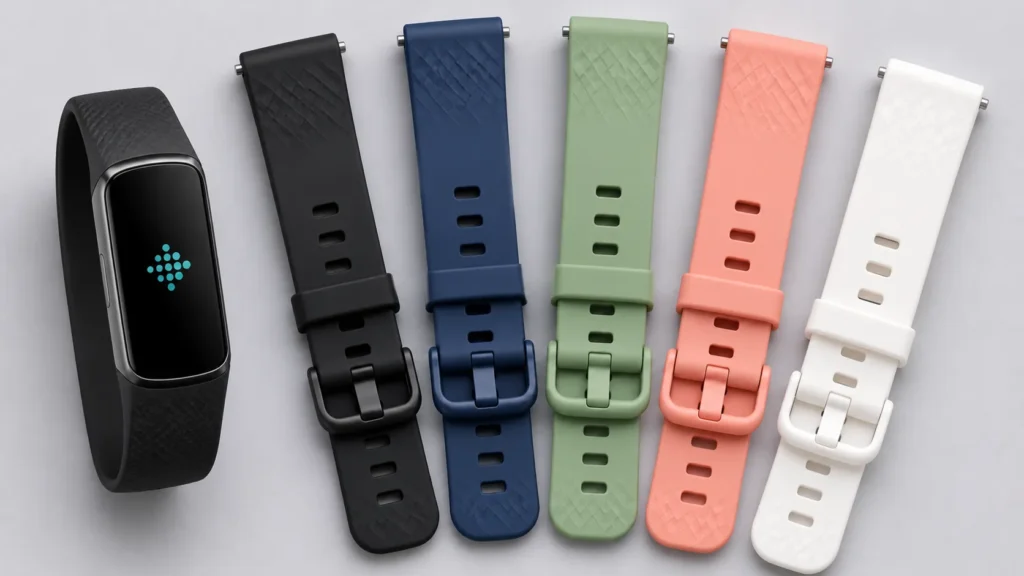
Silicone is the band your Fitbit came with — cheap, waterproof and grippy during a workout. It’s also the band most owners end up replacing first, usually because the stock one traps sweat, picks up a smell, or leaves a mark after a few days of 24/7 wear. The good news is that a better silicone band fixes almost all of that for a few dollars, and swapping takes seconds. This guide picks the best silicone bands for every current Fitbit — Charge, Versa, Sense, Luxe, Inspire and the new Fitbit Air — and explains the breathability, grade and sizing details that decide whether a silicone band feels great or annoying.
Quick answer: For everyday wear and workouts, pick a perforated (breathable) silicone sport band in a softer grade — it vents sweat and stays comfortable for sleep tracking. If the stock band irritated your skin, a soft medical-grade silicone or FKM band worn one notch looser, rotated with a breathable nylon band, solves it. Multi-packs are great value if you like changing colours; a single premium band lasts longer for daily wear. The one rule that matters: buy the band made for your exact Fitbit model — silicone bands are not interchangeable across the Charge, Versa/Sense, Luxe, Inspire and Air families.
Do all Fitbits use the same silicone band?
No — and this is the mistake that leads to most returns. Fitbit uses a different band attachment for each product family, so a silicone band is only interchangeable within its family, not across the whole range:
- Charge 5 and Charge 6 share the same band, so bands are interchangeable between those two.
- Versa 3, Versa 4, Sense and Sense 2 all share one band system — a band for any of them fits the others.
- Versa 1, Versa 2 and Versa Lite use the older, wider Versa band (not compatible with Versa 3/4).
- Luxe, the Inspire 2 and Inspire 3, and the newer Fitbit Air each use their own dedicated bands.
So before you buy, match the listing to your exact model. If you’re not sure which families share bands, our guide on whether Fitbit bands are interchangeable breaks it down, and how to change a watch band covers the quick-release/pin swap itself.
Best silicone band by Fitbit model
Fitbit Charge 5 & Charge 6
The Charge is the most-swapped Fitbit, and a perforated silicone sport band is the upgrade most owners want: better airflow than the stock band and a secure pin-and-tuck fit for the gym. If you wear it to sleep, choose a soft-grade band and keep a breathable nylon loop in rotation for overnight. Browse the full Fitbit bands collection for 20mm-style Charge options.
Fitbit Versa 3 / Versa 4 & Sense / Sense 2
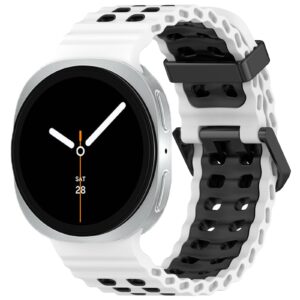
Because these four share a band, you have the widest silicone choice here. A soft sport band with ventilation channels is the best all-rounder; a slim, solid-colour band dresses the Versa/Sense down for the office. Infinity-style bands (no buckle, tuck-through) look cleanest but check the wrist-size range before buying.
Fitbit Versa 1 / Versa 2 / Versa Lite
The original Versa band is wider and uses a different clasp, so buy one explicitly listed for Versa 1/2/Lite. Silicone options are still plentiful and cheap; a classic buckle band with a few ventilation holes is the safe pick.
Fitbit Luxe & Inspire 2 / 3
These slim trackers suit a thinner silicone band. Luxe in particular looks best in a narrow, solid-colour silicone or a soft pastel; for the Inspire, a lightweight sport band keeps the tracker low-profile for all-day wear and sleep.
Fitbit Air
The Air is Fitbit’s newest tracker and most roundups still ignore it — but silicone options already exist. For a secure dressy fit, a silicone band with a butterfly buckle works well; for workouts and easy on/off, a magnetic silicone sport strap adjusts to any wrist. See our dedicated Fitbit Air replacement bands guide for more.
Silicone grades: why some bands feel so much better
“Silicone” isn’t one material, and the grade explains why a $4 band can feel sticky while a slightly pricier one feels soft and dry. Most roundups skip this entirely:
- Standard silicone — the common, cheapest type. Fine, but tends to attract dust and lint and can feel tacky in heat.
- Soft / medical-grade silicone — smoother and gentler on skin; the best choice if the stock band irritated you.
- FKM (fluoroelastomer) — a premium rubber used on sports watches. It’s more sweat-resistant, less sticky and more durable than standard silicone, for a little more money.
- TPU — firmer and glossier; cheap and water-resistant but less soft against the skin than silicone.
For daily wear and workouts, a soft-grade silicone or FKM band is worth the small premium. For a drawer of spare colours, standard silicone multi-packs are fine.
Breathability, sweat and skin: getting silicone right
The single most common complaint Fitbit owners raise — across r/fitbit and beyond — is skin irritation or a rash from the stock silicone band. It’s rarely a true silicone allergy; far more often it’s trapped sweat and friction under a non-breathable band worn too tightly, especially during sleep tracking and long workouts. The fixes are simple:
- Choose a perforated or channelled silicone band so sweat can escape, or a softer medical-grade silicone.
- Wear it one notch looser — snug enough for the sensor, loose enough to slide a finger under.
- Rotate materials: many owners keep a breathable nylon or elastic band for the gym and sleep, and silicone for everyday. If you suspect a genuine sensitivity, switching away from silicone to nylon or metal usually settles it.
- Give your wrist a short break overnight if you notice redness, and keep the band clean and dry (below).
If a true silicone allergy is the issue rather than sweat, see the nylon, elastic and metal picks in our best Fitbit bands roundup.
Cleaning and odor: keeping a silicone band fresh
Silicone that starts to smell is the second big complaint, and it’s caused by sweat, soap and skin oils building up against the skin side of the band. To keep it fresh: rinse the band under water after sweaty wear, wash it weekly with a little mild soap, rub gently, rinse thoroughly and dry it completely before putting it back on — a damp band is what breeds odour. Avoid harsh alcohol wipes on soft silicone over time, and take the band off the tracker for a proper clean now and then. A perforated band both vents sweat and dries faster, so it tends to smell less in the first place.
Multi-pack value vs a single premium band
Amazon and brand stores sell silicone bands in 2-, 5- and even 8-packs, and the cost-per-band is tiny. They’re genuinely good value if you like changing colours or want backups — and a spare is handy for exactly the rinse-and-dry routine above. The trade-off is quality: a single premium soft-grade or FKM band usually fits better, lasts longer and feels nicer day to day. The approach most people land on is a multi-pack for variety plus one premium band for daily wear.
Sizing, fit and buckle types
Two things decide fit beyond the model. First, wrist size: silicone bands usually come in Small and Large, so check the listed wrist range, and if you’re between sizes or have a small wrist, an adjustable or magnetic band avoids the “between two holes” problem. Second, the closure:
- Pin-and-tuck — the Fitbit-style buckle with the loose end tucked under. Low-profile and secure; the default for sport bands.
- Butterfly / deployant clasp — folds flush, looks dressier, no dangling end. Nice for the office.
- Magnetic — infinitely adjustable and fast on/off, ideal for small or large wrists and easy swaps.
For more silicone styles across brands, browse the silicone watch bands collection.
Frequently asked questions
Is the default silicone band on a Fitbit good for long-term use?
For occasional wear it’s fine, but for 24/7 use many people find the stock silicone band traps sweat during workouts and sleep and feels less breathable over months. An aftermarket band with perforations, a softer grade, or a looser pin-and-tuck fit is usually more comfortable long-term.
Why does my silicone Fitbit band give me a rash?
Usually it’s trapped sweat and friction from a non-breathable band worn too tight, not a true allergy. Rinse and dry the band after workouts, wear it a notch looser, choose a perforated or soft-grade silicone, and rotate with a breathable nylon band. If irritation persists, you may have a genuine sensitivity — switch to nylon or metal.
How do I stop my silicone band from smelling?
Rinse it after sweaty wear, wash it weekly with mild soap, rinse well and dry it completely before wearing — a damp band is what causes odour. A perforated band dries faster and smells less. Keeping a spare band to rotate also helps.
Can I replace the silicone band on my Fitbit Charge 6 with a nylon or velcro loop?
Yes. Charge 6 (and Charge 5) owners commonly swap the silicone band for a breathable nylon or velcro sport loop for better airflow and an adjustable fit. Just confirm the loop is listed as compatible with Charge 5/6, since the attachment differs from the Versa and Sense lines.
Are all Fitbit silicone bands interchangeable?
No. Bands are only interchangeable within a family — Charge 5/6 share, and Versa 3/4 and Sense/Sense 2 share — but the Versa 1/2/Lite, Luxe, Inspire and Fitbit Air each use their own bands. Always match the band to your exact model.
Is silicone worse than other Fitbit band materials?
Silicone isn’t bad — it’s waterproof and grippy — but standard silicone can trap moisture and attract dust, which is why some long-term wearers prefer nylon, elastic or metal. FKM and soft medical-grade silicone fix most of silicone’s downsides. A common setup is silicone for activity and a metal or nylon band for going out.
Are multi-pack silicone bands worth it?
They’re good value if you like changing colours often or want backups, and they’re cheap per band. A single premium band tends to last longer and fit better. Many people buy a multi-pack for variety plus one premium band for daily wear.
About this guide: these picks and fixes draw on the real problems Fitbit owners describe in communities such as r/fitbit — band rash, trapped sweat, odour, and which bands actually fit which model — combined with hands-on experience swapping silicone, nylon and FKM bands across the Fitbit lineup. Last updated November 2026.

Comments