
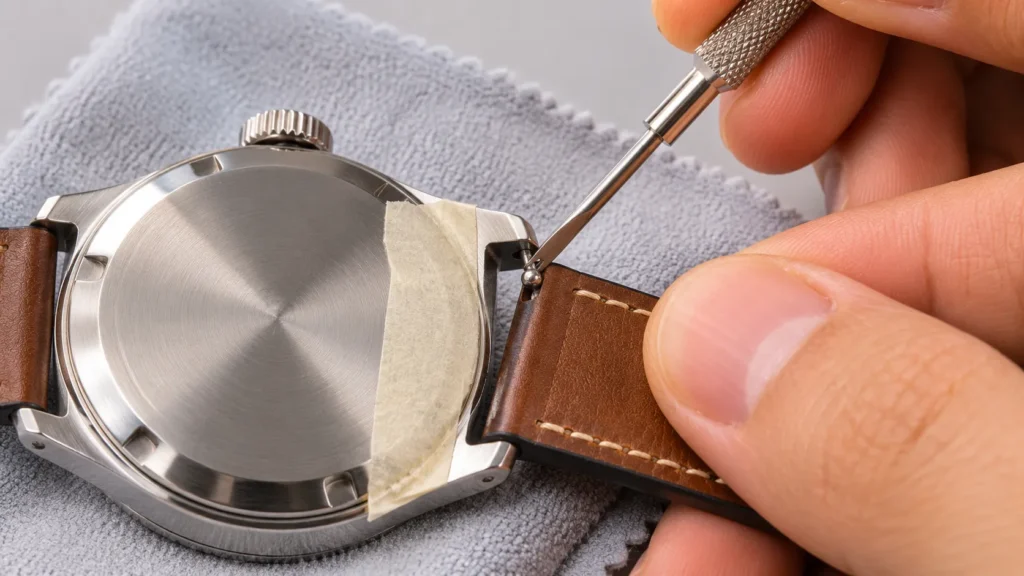
You don’t always need a spring bar tool to change a watch band. With a small screwdriver or even a loop of dental floss, you can swap most straps at the kitchen table in a couple of minutes. The catch: a few band types genuinely do need a tool, and the biggest risk when you improvise is a slipped point scratching the case. This guide covers the safe no-tool methods, the household items that actually work, how to avoid scratches, and the moment it’s smarter to spend a few dollars on a proper tool. For the full walkthrough by attachment type, see our main guide on how to change a watch band.
Quick answer: If your band has a quick-release tab, no tool is needed at all — just slide the tiny lever and lift. For a standard spring bar, the safest no-tool method is a small flathead eyeglass screwdriver (or a loop of dental floss) to compress the spring bar while you angle the band out. Always work face-down on a soft cloth and put a strip of tape along the lugs so a slip can’t scratch the case. Avoid knives and razor blades. Screw-type lugs and metal link bracelets are the exception — those really do need the right tool.
First, look at your lugs — some bands need no tool at all
Before improvising anything, check how your band actually attaches. It falls into one of these:
- Quick-release spring bars — look for a tiny lever or knurled tab on the underside of the band. Slide it and the band pops off. Zero tools. Most modern smartwatch and fashion-watch straps use this.
- Drilled lugs — if you can see a small hole on the outside of each lug, you can push the spring bar in from outside with a pushpin or paperclip. Very easy, very low-risk.
- Standard (non-drilled) spring bars — no quick-release tab and no external hole. You compress the spring bar from the gap between the band and the lug. This is where the household-item methods below come in.
- Screw-type lugs (e.g. some Cartier and designer watches) — the bar is held by actual screws. These need a correctly sized screwdriver, not a hack.
- Metal link bracelets — removing the bracelet is one thing, but resizing it means pushing out link pins, which needs a tool.
If you have quick-release or drilled lugs, you’re done in seconds. The rest of this guide is for standard spring bars.
The safest no-tool methods for a standard spring bar
Two household items do the job well without much scratch risk:
1. A small flathead (eyeglass) screwdriver
The little flathead from an eyeglass-repair kit is the closest thing to a real tool. Turn the watch face-down, find the spring bar between the band and the lug, slip the blade onto the shoulder of the spring bar, and push it toward the centre to compress it. While it’s compressed, angle that end of the band out of the lug. Work slowly so the blade can’t jump.
2. A loop of dental floss
For a scratch-free option, loop a length of dental floss around the spring bar, pull both ends toward the centre of the watch to compress it, and lift the band out. Floss can’t scratch the case, which is why watch owners like it for nicer pieces. A thin strip of folded paper or a cable tie can work the same way.
A thin, blunt butter knife can also compress a spring bar in a pinch, but it’s wider and more likely to slip — use it only if nothing else is to hand, and never a sharp knife or razor blade.
How to change the band without scratching your watch
Scratching the case is the number-one regret people have when they skip the tool — so this part matters as much as the method:
- Tape the lugs. Run a strip of masking or painter’s tape along the case right next to each lug. If the tool slips, it hits tape, not steel.
- Work face-down on a soft cloth. A microfibre or lint-free cloth protects the glass and crown and stops the watch sliding.
- Push toward the centre, don’t pry against the case. All the force should move the spring bar inward, never lever against the lug wall.
- Angle, don’t yank. Once one side of the bar is compressed, lift that end out at a slight angle — it releases cleanly without needing force.
- Mind your fingers. A compressed spring bar can ping across the room. Cup your free hand over it.
Putting the new band on without tools
Installation is the reverse and usually easier:
- Reuse the existing spring bars if they’re in good shape — they’re a standard size for your lug width.
- Hook one end of the spring bar into its hole in the lug.
- Compress the other end with your screwdriver or floss, push the band into position, and let the bar spring into the opposite hole.
- Give the band a firm tug on both sides to confirm it’s locked before you wear it.
Not sure your new band is the right width? Our pillar guide covers measuring lug width and matching a band so the replacement actually fits.
When you genuinely need a tool (don’t force it)
Some jobs aren’t worth improvising:
- Screw-type lugs (certain Cartier and designer models) use real screws — use the correct screwdriver, or a watchmaker, rather than risk stripping them.
- Resizing a metal link bracelet means pushing out link pins, which needs a pin-pusher or the bracelet’s screw system. Household items will damage it.
- A stuck or over-tight spring bar that won’t compress — stop before you scratch the watch.
In these cases, a basic spring bar tool costs only a few dollars and pays for itself the first time, especially if you change bands often or own a watch you’d hate to mark. For a valuable or vintage piece, a jeweller’s fee is cheap insurance.
Want to skip tools for good? Buy no-tool bands
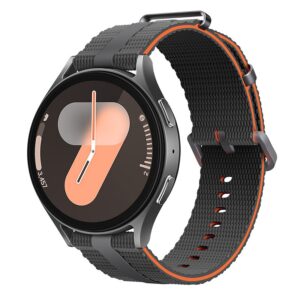
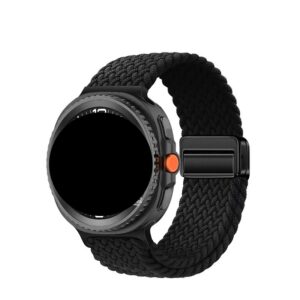
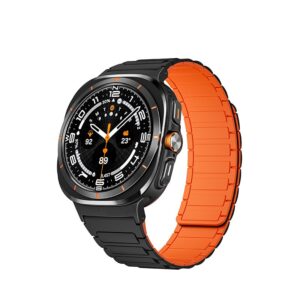
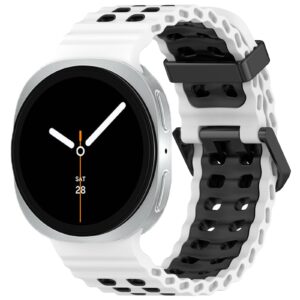
The easiest long-term fix is to use straps that never need a tool. Quick-release bands have the built-in lever, and NATO or slip-through straps thread under the watch with the spring bars left in place — nothing to remove at all. Browse silicone quick-release bands or Milanese mesh bands for tool-free options. Changing a smartwatch strap in particular is almost always tool-free — see our Samsung Galaxy Watch band guide for the quick-release method, and our roundups of the best Samsung Galaxy Watch bands and best Fitbit bands.
Frequently asked questions
Do people really change their own watch bands?
Yes — plenty of watch owners swap their own bands to save time and money, and with the right technique and a couple of household items it’s a simple job. For a valuable or vintage watch, many still prefer a professional to avoid any risk of scratches.
Can I change a watch band with no tools at all?
If your band has a quick-release tab or drilled lugs, yes — completely tool-free. For a standard spring bar you’ll need something small to compress the bar, like an eyeglass screwdriver or a loop of dental floss, but no dedicated spring bar tool is required.
What household items can I use to remove a spring bar?
A small flathead eyeglass screwdriver works best. A loop of dental floss is the most scratch-safe. A thin folded strip of paper, a cable tie, or a blunt butter knife can also work. Avoid sharp knives and razor blades — they slip and are dangerous.
How do I change a band without scratching the watch?
Tape the lugs, work face-down on a soft cloth, and always push the spring bar toward the centre rather than prying against the case. Those three steps prevent almost all scratches.
How do I swap an Omega (or similar) band without tools?
Most Omega straps use standard spring bars, so the same methods apply — compress the bar with a small flathead or dental floss and angle the band out. For a high-value watch, tape the lugs first, or have a jeweller do it to be safe.
When should I just buy a spring bar tool?
If you change bands often, own a watch you’d hate to scratch, or have screw-type lugs or a metal bracelet to resize, buy one — they cost only a few dollars. For a one-off swap of a quick-release or standard-spring-bar band, household items are fine.
About this guide: the methods and warnings here reflect the real techniques and cautions watch owners share in communities such as r/watches — what actually works, and where people most often scratch a case — combined with hands-on experience changing bands across quick-release, spring-bar and NATO setups. Last updated November 2026.

Comments